


There is an oversupply of coaches on LinkedIn.
The market is crowded, the noise is deafening, and most coaches struggle to stand out.
Many coaches have built their businesses on referrals.
That works well until it doesn’t.
When referrals dry up and they turn to LinkedIn, they flounder.
Here is why.
Why Most Coaches Struggle on LinkedIn
Coaches spend a lot of time doing hours with other coaches. This creates a shared language. This language then gets put into their marketing.
Coaches love words like “transformation,” “alignment,” “unlocking potential,” and “stepping into your power.”
Buyers don’t think in those terms.
They think in pains, problems, and outcomes.
They want to know what changes in their day to day life.
Coaches talk about what they do, not what it does. “I’m an executive coach” means nothing to a prospect.
What problem do you solve?
What does life look like after working with you?
Don’t cast a wide net.
Coaches often struggle to define a specific transformation because what fits one client won’t fit another.
So they try to appeal widely without the budget or time to take on a wide audience.
They end up competing with noise without the resources to do it.
And believe me, LinkedIn is noisy.
The Real Shift Coaches Need to Make
If you want clients to come to you, zero in on why people buy.
They don’t want coaching.
They want transformation.
A change from their current day to day to a specific better future.
Until you articulate that clearly, in language your buyers use, you will keep getting referrals and no opportunities from LinkedIn.
How to Win Clients as a Coach in 2026
You are a great coach.
You have a lot to give. Trying to do everything will burn you out.
Instead, own one problem and one audience.
Without this, you cannot build a message and approach that resonates.
Solve one real world problem via coaching. Yes, you solve many. You cannot market many and resonate.
Map out the problems you solve.
Then limit your focus so you gain traction more quickly.
On average, it takes 11 touch points for someone to actively consider buying from you.
If you are vague and woolly, you extend that by a factor of 5.
This is what many people miss about niching.
They think they are keeping their options open by appeal broadly.
In reality, they are creating confusion and friction.
They have market harder to overcome it.
Do you really want to slow down people “getting” your value or would you rather accelerate it?
Niching allows you to resonate and convert faster.
Pick one problem to solve.
Here is what a good niche looks like versus a bad one:
Bad: “I help leaders get unstuck.” Why it fails: Vague. What does unstuck mean? Unstuck from what? Every leader has different challenges. This resonates with no one specifically.
Good: “I help first time engineering managers stop losing their best developers in the first 90 days.” Why it works: Specific audience (first time engineering managers). Specific problem (losing developers). Specific timeframe (first 90 days). The right person reads this and thinks “that is me.”
Bad: “Executive coach for senior leaders.” Why it fails: A job title, not a solution. No indication of what changes for the client. Isn’t that every executive coach?
Good: “I help CFOs who have been promoted from finance director stop working 70 hour weeks and start leading strategically within 6 months.”
Why it works: Clear audience (newly promoted CFOs). Clear pain (70 hour weeks, stuck in operational work). Clear outcome (strategic leadership). Clear timeframe (6 months).
Pick a Subset of Your Market
Not a million people. More like 20,000.
This is a corner of your bigger market that resonates with the problem you have chosen to own.
Now you own the problem and the audience more easily.
Let’s face it.
You don’t need hundreds of clients.
20 would probably max out your capacity.
A 20,000 person market is small enough to build your authority and brand, and big enough to sustain your business for the foreseeable future.
Map Out How the Problem Shows Up
Now you get specific.
How does that root cause problem show up in their day to day?
What does it look like? What does it feel like?
What are they saying to themselves?
This is where your message comes from.
Here is an example. If you coach newly promoted engineering managers who are losing developers:
How it shows up: They are in back to back meetings. They have no time to code anymore and miss it. Their best developer handed in notice last month. They feel like an imposter. They are firefighting instead of leading. Their skip level meetings are awkward. They don’t know how to have difficult conversations. They got promoted because they were a great engineer, not because they knew how to manage.
What they are saying to themselves: “I was better as an individual contributor.” “I don’t know what I’m doing.” “Why did I take this promotion?” “I’m going to get found out.”
This is the language you use in your content and profile.
Not coaching jargon. Their words.
Build Your Message
Your message needs to reflect across your profile, posts, and outreach.
The aim is that your audience sees their lived experience in what you share.
Not conceptually. Tangibly.
Use their common phrasing and words to describe their situation.
This does two things.
It causes them to pay attention.
And it builds massive trust, because you understand them.
Here is the difference:
Vague message: “I help leaders develop their leadership skills and reach their full potential through personalised coaching programmes.”
Resonant message: “You got promoted because you were the best engineer on the team. Now you are in meetings all day, your best people are leaving, and you feel like a fraud. I help first time engineering managers become the leader their team actually wants to follow.”
The second version describes their lived experience. It names the feelings they have. It speaks to them directly.
One important point on content. People don’t buy because they saw one post. They buy because they have consumed 2 to 4 hours of your content. That means a consistent message that builds trust, connects you with them, and deeply resonates with where they are at.
Content is your long game nurturing.
Build a Lead Generation Process
You cannot rely solely on content.
Placing your business and lead generation into the hands of an algorithm that owes you no loyalty is foolish.
It is a lottery, not a strategy.
You need a repeatable process.
My preferred approach is LinkedIn Newsletters and LinkedIn Events.
They favour depth over short form posting.
Over the last 5 years, I have hosted more than 200 LinkedIn events and generated more than 80,000 leads. I only need 200 clients per year and I am done.
This might seem overkill.
For you to close 2 to 3 clients per month, you need around 100 leads per month.
Why 100?
Some won’t be ready yet.
Some will need more nurturing.
Some won’t be a fit. That is why 100 matters.
One event per month is all you need.
Why LinkedIn Events Work So Well for Coaches
Most coaches tell me their biggest problem is not converting leads.
When they get on calls, they close the majority.
The issue is a flow of leads.
LinkedIn events solve that easily and quickly.
The reason I advocate for them so strongly for coaches is simple.
Trust.
Coaching is deeply personal.
It is not only “will this coach get me where I want to go?”
You have to fit.
The client needs to see you as a guide they want to work with.
Events let them experience you. They see how you think, how you communicate, whether you understand their world. That builds trust faster than any amount of content.
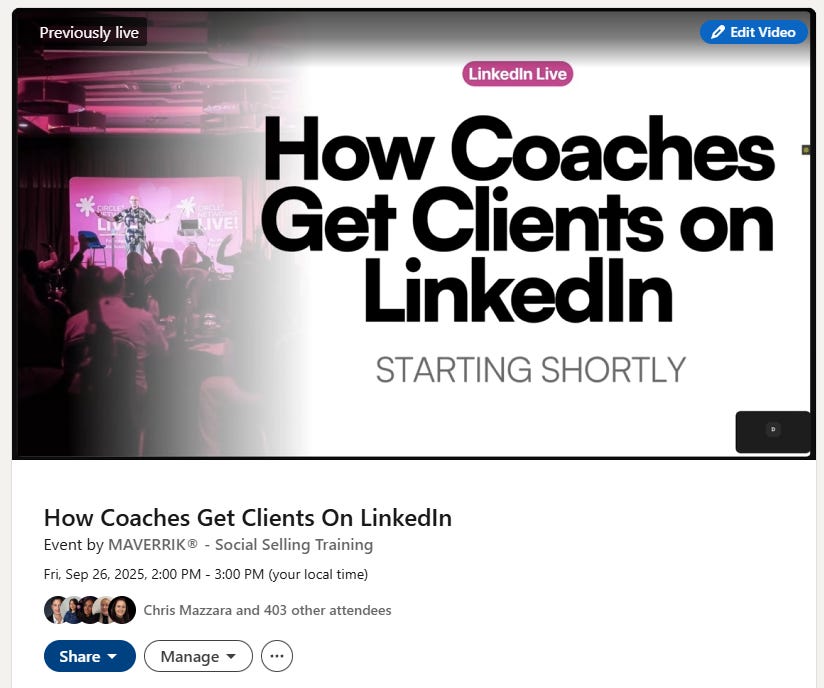
Watch my 60-min live on building a coaching business on LinkedIn:
The Beauty of This Approach
It does not require tons of activity.
Host an event once per month. Follow up and start conversations. Next month, repeat.
It is predictable. It is not all consuming. And it is easy for anyone to get started.
Your Action Plan for This Week
Day 1: List every problem you solve as a coach. Write down at least 10. Be specific about the symptoms, not the root cause.
Day 2: Pick one problem from your list. Choose the one where you have the most proof, the most passion, or the most experience. This is your focus.
Day 3: Define your subset audience. Not “leaders” or “executives.” Get specific. What industry? What role? What stage of career? What situation are they in? Aim for a market of around 20,000 people.
Day 4: Write down 10 ways this problem shows up in their day to day. What do they experience? What do they feel? What do they say to themselves? Talk to past clients if you need to.
Day 5: Rewrite your LinkedIn headline using the problem and audience you have defined. Use their language, not coaching jargon.
Day 6: Plan your first LinkedIn event. Pick a topic that addresses the problem directly. Something like “How [specific audience] can [solve specific problem] without [common frustration].”
Day 7: Create the event on LinkedIn and invite your connections who fit your target audience.
Repeat the event monthly.
Follow up with every attendee.
Start conversations. Book calls. Close clients.
Next steps for you
If you’d want build that flow of leads each month - Schedule a 1:1 call with me